

Guides
27 Easy Guitar Songs for Beginners

Aug
We’ve chosen popular songs that contain a variety of chords, tempos, and genres to keep things fresh throughout the list. We’ve also included a mix of acoustic and electric songs.
It’s up to you how far you’d like to go with practising each song.
If want to just get the main chords down so you can sing over the top, that’s fine! For others, you might wish to get the main chords locked in, then start improvising fills and solos to embellish your music even further.
Basic chords you need to know
Put simply, a chord is a group of notes played together at the same time. You’ll see two types of chords referred to in guitar speak: open chords and barre (pronounced ‘bar’) chords.
- Open chords are played near the nut (headstock of the guitar), with some strings left to ring openly – without you pressing down any frets.
- Barre chords don’t have any open strings in them, so they can be moved around the guitar neck to change the pitch of the chord.
In terms of difficulty, open chords are generally easier as you don’t have to hold down multiple strings with one finger or stretch your fingers too much.
Some good ones to start with are C, D, E, and G in the open position.
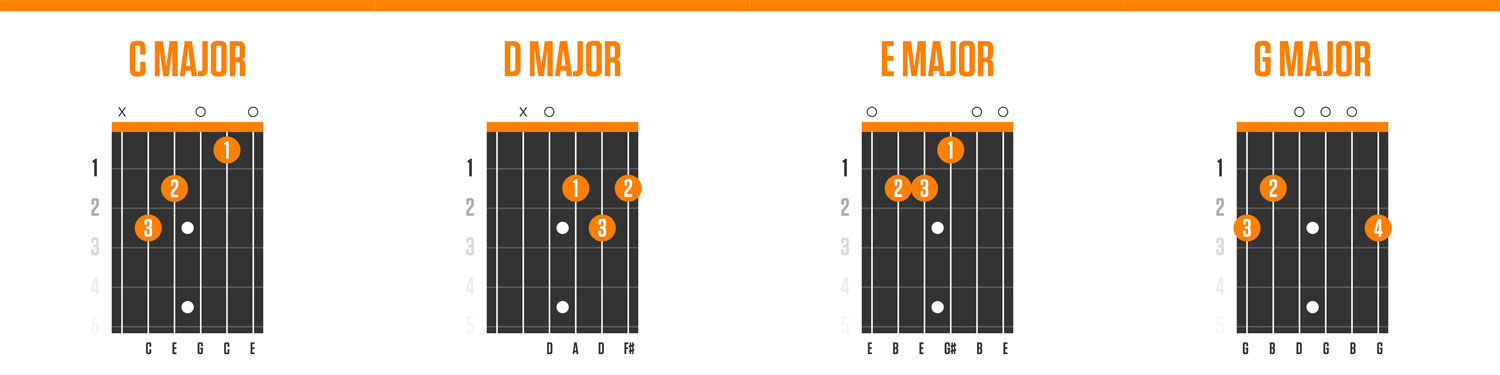
These diagrams represent the neck of a guitar, with the dots on the grid showing you which fingers (1 is index, 2 is your middle, 3 is your ring, and 4 is your pinky) to place on which frets. The dots on the top indicate which strings need to be played and which you should leave muted.
Want to get creative? You can move chords further up the neck with a handy capo, like the Fender Dragon, for interesting key changes!
👉 Book your lesson today at Marvin Empire – Online, Home, or In-Studio.
27 Easy Guitar Songs for Beginners
1. “Paranoid” by Black Sabbath
Raise your rock hands because “Paranoid” is perhaps one of the most legendary metal songs in existence.
Starting with two strums of an E power chord on the 7th fret, you’ll instantly feel like a rock god! That strong chord is followed by a cool little hammer-on riff in the same position and E, A, and D power chords in a steadily down-picked fashion.
Listen to the song closely to pick up the rhythm and you’ll soon be bopping along to one of the most iconic songs of the ’70s.
2. “Someone You Loved” by Lewis Capaldi
Requires a capo on 1st fret.
A soulful hit by Scottish bard Lewis Capaldi, this is a great song to strum and sing, with it consisting of C, G, Am, and F chords.
You can either strum repeatedly at a slow pace to match the mood of the song or, if you’re feeling advanced, fingerpick the individual strings for more melodic quality.
Later, there are some variations of the basic chords, but don’t worry! These are super easy to play. There are Am7 and Dm7 in the bridge which only require some slight adjustments from the normal open chords.
3. “Sweet Home Alabama” by Lynyrd Skynyrd
A fun, iconic riff that instantly takes you to the American south. It works around D, C, and G open chord shapes, so if you’ve practised these chords, you’ll quickly pick it up.
It isn’t too complex, and the more you run it, the speedier and ‘twangier’ your playing will become.
Keep your pinky finger on the 3rd fret of the B string, then your other fingers will naturally slot into the C and G chord shapes. The trick to perfecting it is to play along with the song, carefully matching the beat and picking style of Skynard.
And because the riff ends where it starts, it’s a breeze to just keep playing it on repeat! Trust us, you’ll be picking this riff blindfolded in no time at all.

4. “Free Fallin” by Tom Petty
Requires a capo on 3rd fret.
Covered by many artists over the years, this is a simple chord progression that you can quickly master and sing over the top.
With a capo on the 3rd fret, you’ll play open D, A, and E chords, with a Dsus4 chord thrown in to mix it up. Not to worry, Dsus4 is a D chord with your pinky on the 3rd fret rather than the 2nd.
Suitable for both acoustic and electric (try adding a little crunch for a classic rock tone), you’ll be dad rocking in no time with this classic hit.
5. “My Generation” by The Who
Incredibly easy to play and incredibly easy to rock out to. “My Generation” consists of two chords: G and F. Play them as power chords to get that meaty rock sound and let loose with your roaring vocals in the pauses.
This ’60s mega-hit is particularly famous for its bass solo, but Pete Townshend’s guitar fills are your cue to add some improvisations of your own!
It’s a great song to develop your soloing skills as there’s nothing too complex going on with the rhythm or chords.
6. “House of the Rising Sun” by The Animals
House Of The Rising Sun revolves around Am, C, D, E, and F chords. Rather than strumming them, pick each note of the chord, ascending and descending in pitch to create the bluesy and sombre tone of the song.
Later in the song, you’ll see a C/E chord, which is a C chord with an E note as the bass note. It’s super simple to play – just a step out of the usual open chord structure!
There’s also E7 and F7, which add in 7th notes from the scale. Again, simple variations of the open chords which crop up once or twice in the song to add tension to a line.
7. “Achy Breaky Heart” by Billy Ray Cyrus
If you’re in the mood for some two-step, then this rootin’ tootin’ song from mullet-wielding weirdo Billy Ray Cyrus will do the trick.
A solid country-style jam, “Achy Breaky Heart” consists of just two chords: A and E (appropriate because this song belongs in Accidents and Emergencies).
The simplicity gives you loads of room to try out country-style licks using the notes you find in open A and E.
Look for scales in the key of A and you can also start improvising solos over the top – and if really want to get advanced, try out chicken pickin’ techniques for a real country sound.

8. “American Idiot” by Green Day
“American Idiot” smashed the pop charts back in 2003, and it’s still fun as ever to play.
The main riff is three simple power chords in C#, G# and F# positions, with you quickly switching between the three.
At the end of the riff, there’s a short, sharp, and energetic hit of the open strings that signals the start of the vocals.
The solo is fairly simple to pick up too, it involves octave shapes played in quick succession, then an easy lick further up the board.
9. “Three Little Birds” by Bob Marley
Don’t worry about a thing, coz you’ll have this song mastered in no time at all! It’s made of three chords – A, D, and E – played to a reggae beat.
This pattern of strumming can be quite tricky to pick up when you’re new to the genre, so try a regular rhythm first as you get used to the song.
The video below shows you how to nail an easy strumming pattern and the more complex reggae beat strum.

10. “Smells Like Teen Spirit” by Nirvana
A rite of passage for guitar players, this groundbreaking grunge record features four power chords on the 1st fret of the E string, 1st fret of the A string, 4th fret of the E string, and 4th fret of the A string. It’s a really simple rhythm that you can kick out with plenty of attitude.
The key to getting the rhythm correct is to hit the chords a couple of times and fill the gaps between them with muted hits of the strings.
As for the verses, if you hold down the 1st fret of the high E and B strings and pluck them, you’ll have the complete song!
11. “Brown Eyed Girl” by Van Morrison
Eminently singable. It’s hard not to be in a good mood when you’re playing “Brown Eyed Girl”, and that’s because of its sweet G major key.
Featuring easy-strumming open G, C, D and E chords, it’s a great crowd-pleaser to practise your vocals on.
Once you’ve got the chords and rhythm down, why not have a crack at the fun riffy intro?
12. “Wonderwall” by Oasis
Capo on the 2nd fret.
Yes, yes, we know. There’s nothing like “Wonderwall” to make a crowd groan but it’s one of those seminal songs that every guitarist needs in their back pocket.
It’s made up of basic G, C, D, and Em chords – but with a slight twist. Hold down the 3rd fret of the B and high E strings on all chords – this creates that iconic “Wonderwall” treble tone.
Later in the song, we’ve got a G transition chord. This means you simply go from the 3rd fret of the bottom E string to the 2nd fret and play the rest of the strings open – apart from the B and high E, which have the 3rd frets pressed.
The G transition chord is played just once and helps you blend into the Em chord. You’ll see this movement crop up in loads of songs, so it’s good to get under your belt early!

13. “Zombie” by The Cranberries
Soulful, sombre, and emblematic of the ’90s, “Zombie” is super simple to learn with just four chords: Em, Cmaj7, G, and D.
Cmaj7 sounds complex but it’s really the same as open C without you hitting the 1st fret on the B string.
There’s nothing quite as satisfying as belting out “What’s in your heaaaad” as you work through this comfortable chord progression.
14. “Knockin’ On Heaven’s Door” by Bob Dylan/Guns N’ Roses
Originally by vaunted musical poet Bob Dylan and famously covered by Guns N’ Roses, “Knockin’ On Heaven’s Door” is great fun to play and easy to sing along with.
It goes G, D, Am/G, D, C on the verses, alternating between the Am and C as the last chord.
On the chorus, you just stick with the G, D, and C progression, and then start alternating again once you get back to the next verse!
15. “The Joker” by Steve Miller Band
A real earworm. You might not recognise the name of this song, but it’s a breeze to play. It consists of G, Cadd9, and D – all very simple chords, played in a steady pattern.
As you grow confident in playing these and stringing them together, you can start picking the notes individually to mimic the bass line and adding in little licks of your own!
16. “Buck Rogers” by Feeder
A legend from the 2000s – and still a bop today.
“Buck Rogers” has a super simple arrangement with an open Em chord and power chords at the 7th and 9th fret of the low E string. That’s the basic rhythm, and the chorus has an additional power chord at the 5th fret of the low E string, all strummed in a steady beat that’s easy to pick up. I wonder if he ever got that house in Devon?

17. “All The Small Things” by Blink 182
As pop punk as pop punk gets, “All The Small Things” is a smash hit crowd-pleaser that’s sure to get the audience singing.
Revolving around a C power chord on the 3rd fret of the A string, a G power chord on the 3rd of the low E string, and a power chord in the F position, it’s nice and easy to sing along with.
The strumming pattern is quick to learn as it’s all a steady down-pick.
Listen for the palm mutes (where your palm deadens the strings while playing them) in the intro and other slight pauses to get the song memorised.
18. “Chasing Cars” by Snow Patrol
Soulful, catchy, and super easy to play!
Featuring a cool little melodic riff that’s picked throughout most of the song, “Chasing Cars” is a refreshing break from the chord-heavy songs we’ve seen so far. It requires you to pick the power chord shapes rather than strum them.
There’s a little bit of a stretch in which you pick the 5th fret of the A string and the 9th fret of the G string, but it’s great for building that hand strength.
At the end of the song is a series of chords – A, E/G#, D, Dsus2, Dmaj7 – played in a steady, down-picked fashion to match the vocals.

19. “Stand By Me” by Ben E. King
Open chords, a fun intro, and timeless lyrics.
“Stand by Me” is one of those songs that you just can’t help but sing along with. That’s good, because the C, Am, F, G chord progression makes it easy to focus on the vocals!
The intro’s riff is brought to life by the timing, so listen closely to the song to pick it up.
As for strumming patterns, you want to be in time with the beat to match the tempo and feel of the song.
20. “Love Me Do” by The Beatles
Super simple and super classic. Consisting of G, C, G7, and D, “Love Me Do” is very fast to pick up and strum along with. G7 simply moves the note from the 3rd fret of the high E string to the 1st.
Better still, the strumming pattern is steady and not too complex.
21. “A Horse With No Name” by America
There are no difficult chords here but the strumming pattern is a little different from usual.
Em, D6/9, Em9, and Dmaj9 make up the progression, and it’s very easy to play.
D6/9 is just one fret, Em9 has you holding the 2nd fret of the high E string rather than the A string, and Dmaj9 is a slight variation of the normal D chord.

22. “Blitzkrieg Bop” by The Ramones
A classic punk tune, “Blitzkrieg Bop” is a super simple song that’s made up of three power chords.
These are located on the 5th fret of the low E string, the 5th fret of the A string, and the 7th fret of the A string – a simple progression to pick up. Play it fast and play it loud!
23. “What’s Up?” by 4 Non Blondes
Three chords, simple strumming pattern, and soulful vocals.
G, Am, and C are all you need to master 4 Non Blondes’ “What’s Up?”.
The strumming goes slow to fast on each bar, so it’s quick to get into the rhythm of the entire song.
24. “Good Riddance” by Green Day
Mellow and catchy, this is a great song for acoustic lovers.
G, Cadd9, D, Em, and C chords make for a simple progression that’s quick to pick up.
The trick to mastering it is to avoid full strums in the intro and instead play the bottom strings while picking the high E and B strings sequentially. Not long into the song, it moves to standard strumming.

— 👉 Book your lesson today at Marvin Empire – Online, Home, or In-Studio.
25. “Circles” by Post Malone
A really fun tune to strum and sing along with. The strumming pattern is very simple, and the chords are as follows: Cmaj7, Fmaj7, Fm, C, F, C/B, and Cmaj7/B.
While some of these chords look complicated, they’re actually just slight variations on open chords.
If you’re having trouble playing F as a barre chord, you can play it as either a power chord or an open chord.
26. “Otherside” by Red Hot Chilli Peppers
A fun riff and simple chords. Usually, “Otherside” doesn’t have strummed chords in the verses but they work just as well. Featuring Am, F, C, G, Em, and A chords, it’s really simple to get going.
As you progress, you can start playing the riff and melody over a backing track.
27. “Thinking Out Loud” by Ed Sheeran
Requires a capo on 2nd fret.
A nice and slow song with an easy selection of chords. C, C/E, F, G, Dm, and Am are all you need to play the whole tune, but the key is listening closely to pick up the timing.
In particular, the line “maybe we found love right where we are” has a chord change for each word – difficult at first, but you’ll soon have it mastered!
