

Guides
Basic Music Theory for Beginners – The Complete Guide

Aug
This basic music theory guide looks at fundamental concepts musicians use to understand, analyze, and create music.
What is Music Theory?
Music theory is a practice musicians use to understand and communicate the language of music. Musical theory examines the fundamentals of music. It also provides a system to interpret musical compositions. Music theory is a great tool for electronic and pop musicians to elevate tracks.
For example, basic music theory defines the elements that form harmony, melody, and rhythm. It identifies compositional elements such as song form, tempo, notes, chords, key signatures, intervals, scales, and more. It also recognizes musical qualities such as pitch, tone, timbre, texture, dynamics, and others.
How to Learn Music Theory?
Music theory is a complex and extensive subject. There are several practices, disciplines, and concepts.
Best to learn music fundamentals first before exploring advanced music theory. The building blocks that form musical compositions include:
- Harmony
- Melody
- Rhythm
Solidly understanding these three core elements will help you learn basic music theory.
What Is Harmony in Music?
Harmony is when multiple notes or voices play simultaneously to produce a new sound. The combined sounds in harmonies complement one another and sound pleasing.
Chords and chord progressions are examples of harmony. A chord has three or more notes that play at the same time. The chords and chord progressions in a piece of music support or complement the melody.
Combining vocal parts also creates harmony. The combined voices of a choir are a perfect example. The multiple voices that make up a choir blend to make a harmonious sound.
However, not all harmonies are pleasing to our ear. There are two main types of harmony: dissonant and consonant .
- Dissonant harmony adds notes that do not sound pleasant when played together. The result adds tension and makes the chord sound unstable. This tension releases by resolving to consonant chords. Dissonant interval examples are seconds, sevenths, and ninths.
- Consonant harmony sounds stable and pleasing. All the notes in a consonant chord have intervals that play nicely together. Constant chords also transition smoothly with one another in a progression. Consonant interval examples are unison, thirds, fifths, and octaves.
Musicians combine consonant and dissonant harmonies to make the music more exciting and intriguing.
What Is Melody in Music?
Melody is a succession of notes or voices arranged into a musical phrase. A song’s melody is often the most memorable and recognizable part.
Melodies can be created with instruments or vocals. They have two or more notes in a sequence that sound musically pleasing. Most compositions consist of multiple melodies that repeat.
The two primary elements of a melody are pitch and rhythm :
- Pitch is the audio vibration produced by an instrument or voice. It’s how high or low a note will sound. Arranging these pitches in a series creates a melody.
- Rhythm or duration is the length each pitch will sound. These durations are divided into beat divisions like whole notes, half notes, quarter notes, triplets, etc.
Melodies also have two types of melodic motion: conjunct or disjunct .
- Conjunct motion is when notes move by whole or half steps. Conjunct is also the most natural and comfortable to play and sing. There are shorter leaps between notes.
- Disjunct motion has larger leaps between notes. Large interval leaps between notes can make the melody difficult to play or sing. Disjunct motion is also less memorable and smooth sounding.
Musicians combine conjunct and disjunct motion to give melodies more variation and interest.
What Is Rhythm in Music?
Rhythm is an essential element of music with more than one meaning. For example:
- Rhythm is a recurring movement of notes and rests (silences) in time. It’s the human perception of time.
- Rhythm also describes a pattern of strong and weak notes or voices that repeat throughout a song. These patterns can be created with drums, percussion, instruments, and vocals.
The basic elements that comprise musical rhythm include:
- Beat – A repeating pulse that underlies a musical pattern
- Meter – A specific pattern of strong and weak pulses
- Time Signature – The number of beats per measure
- Tempo (BPM) – Indicates how fast or slow a piece of music plays
- Strong and Weak Beats – Strong beats are the downbeats, and weak beats are the offbeats
- Syncopation – Rhythms that accent or emphasize the offbeats
- Accents – Refers to the intensity or emphases placed on notes
Understanding rhythm will help you create great harmonies and melodies.
Also, the rhythm section or pulse propels a piece of music. It acts as the rhythmic backbone for other musical elements.
The Benefits of Music Theory: Why Study Music Theory?
Learning basic music theory is essential for enhancing creativity and developing musical awareness. It’s a challenging but rewarding set of skills to learn.
Knowing how music works will make the music production process easier and help you become an effective music producer.
Is learning music theory required? No. However, you can benefit from learning some aspects of music theory.
— 👉 Book your lesson today at Marvin Empire – Online, Home, or In-Studio.
For example, learning basic music theory will:
- Improve your musical development
- Help you understand how music works
- Help you break through creative blocks
- Make it easier to build chord progressions and melodies
- Help you make informed composition decisions
- Help you achieve expression and evoke emotion
- Improve your critical listening skills
- Speed up your workflow
- Improve your musical form skills
- Make it easy to communicate with other musicians
- Deepen your appreciation for music
- Improve your improvisation skills
- Improve your song arrangement skills
- Help you discover new creative possibilities
Note : Musical theory is not a set of rules or guidelines you must follow. It’s only a tool to help you understand and explain how music works.
The Fundamentals of Music Theory (Music Theory for Dummies)
This basic music theory for beginner’s guide examines the core music fundamentals. It also provides insight into the basic building blocks of music that form harmony, melody, and rhythm.
Musical Notes and Intervals
Let’s start this music theory for beginner’s guide by going over harmony and melody. This section describes all the available notes and the specific relationships between them.
The Music Alphabet
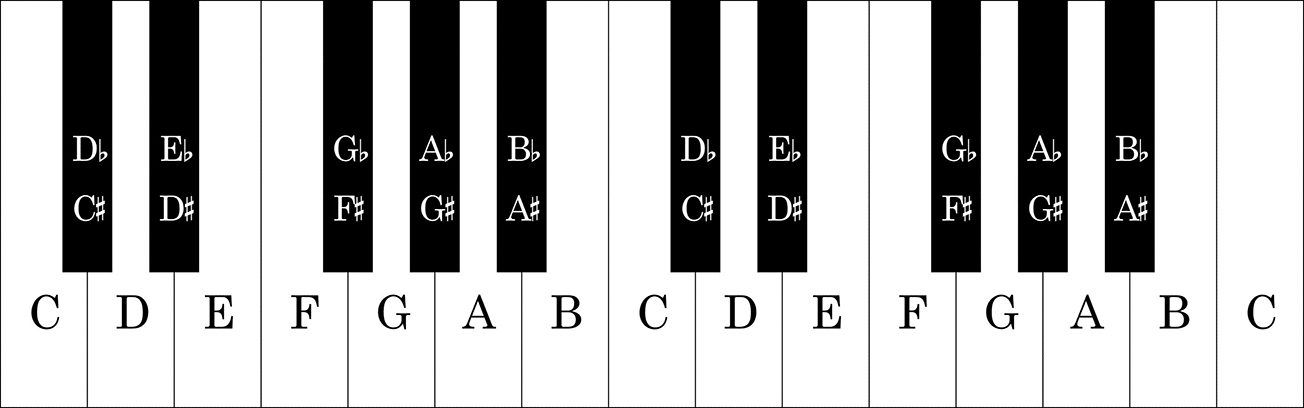
Notes are the building blocks for all music. The musical alphabet consists of seven letters: A, B, C, D, E, F, G . Each note has a unique pitch.
The 12 Keys of Music
There are 12 notes on the piano keyboard: A, A#/B♭, B, C, C#/D♭, D, D#/E♭, E, F, F#/G♭, G, G#/A♭ .
The same 12 notes repeat upwards and downwards in octaves.
White Keys
The white keys on a piano play the “natural” notes in a scale: A, B, C, D, E, F, G .
Playing only white keys places you in either the key of C major or A minor.
Black Keys
The black keys on a piano play the “flat” and “sharp” notes in a scale: A#/B♭, C#/D♭, D#/E♭, F#/G♭, G#/A♭ .
Each note has a symbol: ♭ for flat and # for sharp. Playing a combination of white and black keys allows you to write in all available key signatures.
Intervals
An interval is a distance between two notes. There are several intervals. Measure these intervals by the number of half steps, whole steps, and their position in the scale.
- A half step interval is one semitone
- A whole step interval is two semitones
- Two half steps make a whole-step
Intervals are also the foundation of both harmony and melody. Playing two or more notes at the same time creates harmonic intervals (chords). Playing single notes in a sequence makes melodic intervals (melodies).
Furthermore, we describe intervals by number (distance) and prefix (quality). The interval number represents the number of half-steps between two notes. These numbers are 1st (unison), 2nd, 3rd, 4th, 5th, 6th, 7th, and 8th (octave) .
Lastly, intervals have using a prefix to describe their quality. The five interval qualities are major (M), minor (m), perfect (P), augmented (A), and diminished (d) .
Octaves
Octaves are the next highest or lowest pitch of the same note. The interval between a note and a note double its frequency is an octave. For example, an octave up from C1 on a piano is C2. An octave down would be C0.
There are 12 semitones in the octave. These pitches repeat in the same order throughout the range of human hearing.
Key Signatures
Key signatures tell you what notes in a scale are sharp (♯) or flat (♭). There are twelve key signatures, each derived from the twelve available notes.
Key signatures also help identify the key of a song, which is the tonal center. For example, a song in the key of A minor uses notes from the A minor scale.
Music Scales and Modes
Musical scales form the building blocks of music. Understanding musical scales and their functions is essential when learning basic music theory.
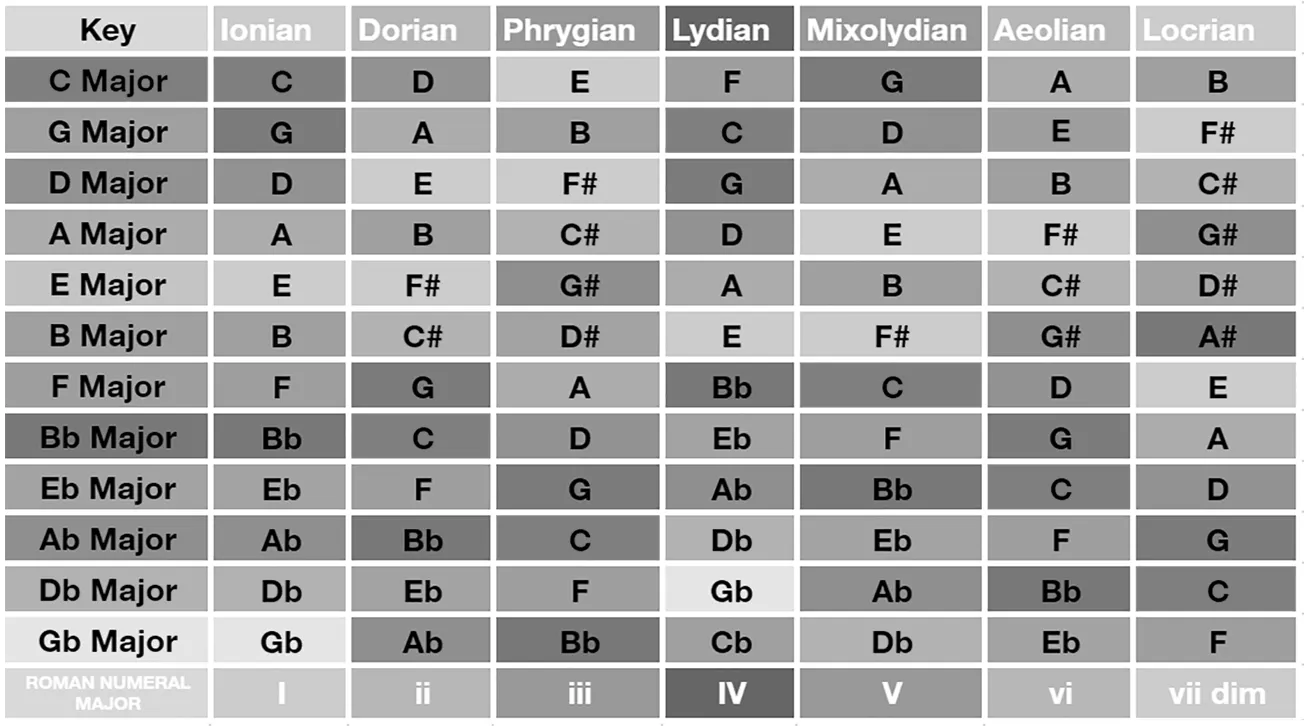
This section looks at the two most common scales, their scale degrees, and the seven music modes.
Music Scales
A music scale is a set of notes within an octave arranged by their pitch. The ascending or descending interval relationships among the note pitches define each scale. Moreover, the notes from a scale form melodies and harmonies.
There are several types of scales. However, the two main types are the major scale and the minor scale. You can build both major and minor scales from any note. How you use them depends on the pattern of intervals you use.
Major Scales
There are twelve possible natural major scales. Natural major scales are bright, uplifting, and happy sounding.
The seven notes in all major scales follow the same interval pattern: W-W-H-W-W-W-H (whole-whole-half-whole-whole-whole-half) .
Minor Scales
Natural minor scales are dark, sad, and emotional sounding. The seven notes in all minor scales follow the same interval pattern: W-H-W-W-H-W-W (whole-half-whole-whole-half-whole-whole) .
There are twelve possible natural minor scales. In addition, there are three variations of the minor scale: natural, harmonic, and melodic.
Scale Degrees
Each note of a scale has a specific name related to its function, called a scale degree. The name is the function, and a number indicates its position on the scale.
There are seven scale degrees. These names apply to all major and minor scales. Learning more about these functions takes us into advanced music theory. For now, it’s good to know the names:
- 1st – Tonic
- 2nd – Supertonic
- 3rd – Mediant
- 4th – Subdominant
- 5th – Dominant
- 6th – Submediant
- 7th – Leading Tone
Music can create and release tension. The function of a scale degree relates to the amount of tension created. It also helps you decide what note(s) should follow to resolve the tension.
Moreover, remembering the different pitches in major and minor scales is difficult. Referring to the steps of the scale by numbers rather than notes makes it easier to remembe
