

Guides
Classical vs. Acoustic vs. Electric: The Best Guitar for a Beginner

Aug
So you’ve decided to learn guitar – congratulations! You’ve chosen one of the most versatile, expressive, and exciting instruments out there.
And choosing a guitar can be very exciting indeed – with three types out there and countless colorways available, picking out the instrument that will sit in your hands and help you make beautiful music is one of the biggest delights of starting out in guitar
Now, as a beginner, you could begin your road to becoming a great guitarist with whichever one. However, depending on your guitar goals and preferences as a player, you may find that one type feels natural and pleasant to play, while another has you grinding your teeth in frustration.
Acoustic, Electric, and Classical Guitars: Similarities and Differences
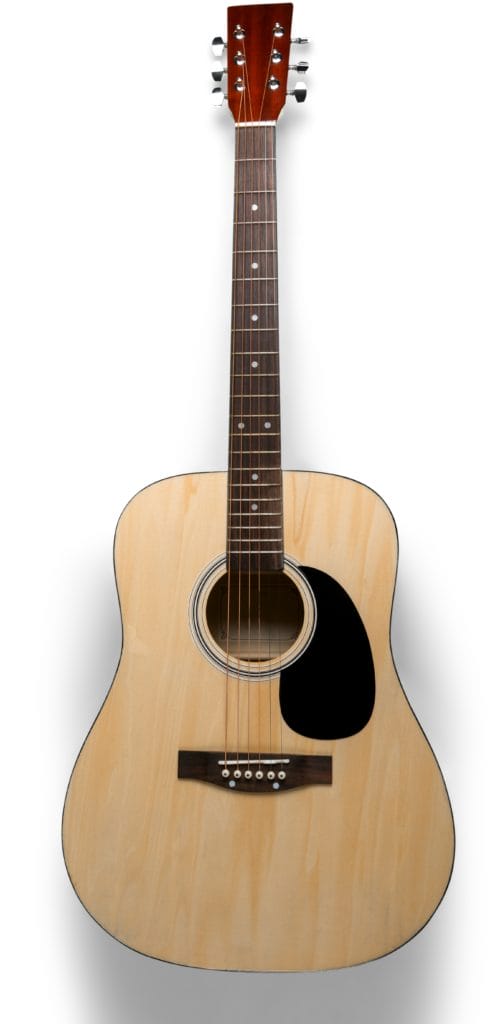
The most common acoustic guitar shape – the “dreadnought”
Even though each guitar type is built in a different way, they all have the same essential parts – the strings, body, neck, fretboard, headstock, and hardware.
Classical guitars are usually outfitted with nylon strings, whereas most acoustic and all electric guitars come with steel strings, which are ostensibly easier to play on.
Furthermore, the body of an acoustic guitar is the largest of the three types, if we’re taking the standard dreadnought shape as an example.
An interesting meeting place between acoustic and electric guitars is the advent of “semi-acoustic” guitars, which can be wired to an amp – the same, however, can’t be said about classical guitars.
In a nutshell, the core and purpose of all guitar types are the same, whereas nearly all the other details are different.
Electric vs. Acoustic vs. Classical – Which One Is The Best For You?
Let’s look at the features and idiosyncrasies of each type of guitar, and the purposes each is best suited to. Beyond the obvious matter of electric guitars being for rock ‘n’ rollers and classical guitars suiting classical and flamenco players, each type of guitar has practical advantages and disadvantages for beginners looking to wrap their head and their fingers around their new instrument.
Let’s look at each type of guitar and how it will impact your learning.
Benefits Of Beginning With An Electric Guitar
Electric guitars are exceptionally easy to play but very difficult to master. The reason why they’re good for beginners is because you’ll be able to play for hours without hurting your fingers – if you feel like you’re not hearing the fretted notes well, simply crank up the volume on your amp.
The strings are quite close together and the neck is narrow, meaning your hand will be able to easily make most chord and scale shapes without having to stretch. Plus, the cutaways on an electric guitar make the upper frets easily accessible, allowing for the exploration of soloing and playing higher up the neck right from day one.
Disadvantages Of Beginning With An Electric Guitar
Most people who begin with electric guitars seldom take up acoustic, let alone classical guitar, ever. The reason is quite simple – electric guitars offer more versatility and they are easier to play.
The real disadvantage here is skipping out on fully mastering the basics – if you want to master chords and scales, the best way to do so is by taking small steps on an acoustic or classical guitar.
Electric guitar is much easier to play as the strings are (usually) lighter, and the sound augmented with electricity will, in most cases, cover your mistakes and make them appear less obvious, so you won’t feel like you need to practice the things immediate beginners on acoustic (and nylon) guitars do.

The basics are exceptionally important for your growth as a musician. The veterans and pros don’t do anything special aside from using their knowledge of the basic skills on a totally different level – the simplest techniques, through practice and repetition, become advanced and make room for even more improvemen
Benefits of Beginning with an Acoustic guitar
Acoustic guitars are usually the weapon of choice for most beginner guitarists. They’re the most balanced guitar type in terms of sound, playability, and they require the least amount of time in order to grasp the basic concept of playing.
👉 Click Marvin Empire for a free consultation – Quick response, Pickup or Same-day delivery.

An acoustic guitar with a cutaway, allowing access to the upper frets
The acoustic guitar is great for practicing the basics – scales, chords, chord progressions, and riffs. You can easily hear if a note is wrong and can correct your mistake accordingly.
The larger shape of acoustic guitars means that they’re a bit heavier, but this actually helps beginners rest their picking arm on the body of the guitar while playing, resulting in less hand fatigue than with electric and classical.
Disadvantages Of Beginning with an Acoustic guitar
There are only two real disadvantages of beginning with an acoustic guitar – firstly, they’re usually more expensive than classical guitars, and secondly, the steel strings will hurt your fingers at first, as you’re getting used to the guitar.
If we take out the price part, we’re left with some pain along the way, so what should you expect?
Steel stringed acoustic guitars are harder to fret than nylon-strung classical guitars, but there’s more resonance, and the chordplay is a bit easier. Steel is naturally harder than nylon, and chords will be easier to nail down on a steel-string guitar because the strings are usually thinner and will give you the aforementioned feel of “locked frets”.
In a nutshell, acoustic guitars are better suited for beginners if you’re able to save up a bit more money.
Benefits of Beginning With A Classical guitar
If you’re a complete beginner, feeling the nylon strings for the first time will dissuade you from trying out steel ones ever. They’re very mellow, feel nice to the touch, and are comfortable to play on.
The classical guitar also features a smaller, more lightweight body than both the acoustic and electric guitar.

A big reason why many beginners opt for classical guitars is the fact that they’re quite a bit cheaper than acoustic and electric guitars.
Disadvantages Of Beginning With A Classical Guitar
Classical guitars are often taught by professionals in music schools as they’re the hardest guitar type to master. Why is that so?
First of all, the nylon strings feel substantially different than steel strings, and people who’ve had some practice with electric or acoustic guitars will feel like complete beginners right off the bat.
Secondly, the sounds that classical guitars emit are airy, and all of your mistakes will be more accentuated. This falls down hard on most beginners, but even though it could help with practice, it should be considered as a disadvantage over the other types.
